

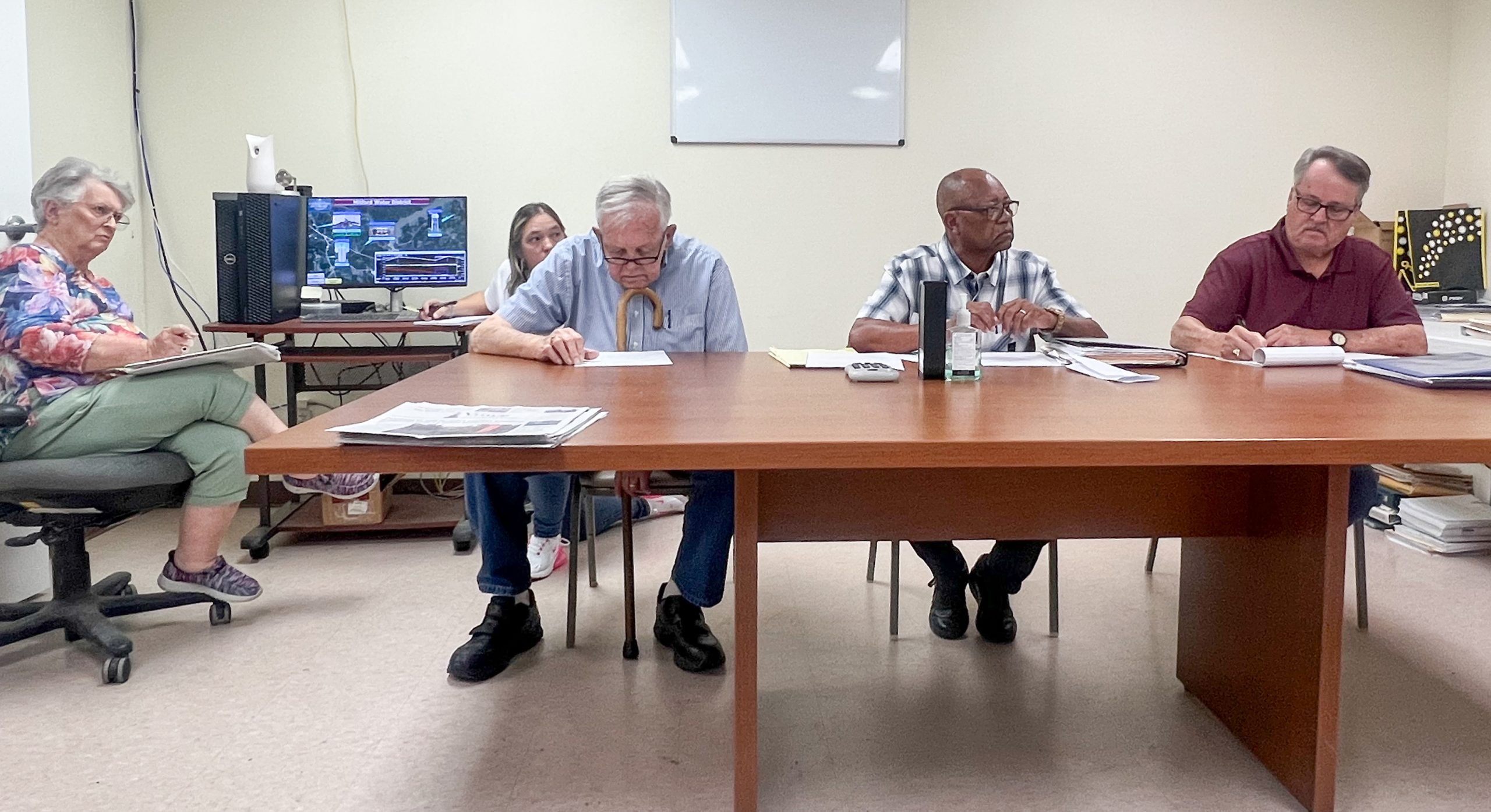
GREAT FALLS – Questions from the audience during the Oct. 15 regular monthly meeting of the Mitford Rural Water District prompted the water board’s only two members to concede they don’t know whether they were legally approved to be on the board.
According to the S.C. Attorney General’s website, neither Board Chair Randy DeWeese nor Vice Chair Mike Godfrey are listed as board members. Former Board Secretary ‘Sonny’ Hudson is listed as the only certified current member of the board, but he resigned at the Sept. 17 annual meeting.
S.C. State Code, states that after being elected to the board by the water district membership, board members must then be appointed by the governor to officially take office.
Article 7, Sec. 6-13-630 states: “The district shall be operated and managed by a board of directors to be known as the Mitford Rural Water District Board of Fairfield and Chester Counties which shall constitute the governing body of the district. The board shall consist of five resident electors of the area who shall be appointed by the Governor, upon the recommendation of a majority of those persons attending a meeting of residents of the area held pursuant to at least one week’s notice in a local newspaper giving the time and place of the meeting.”
As DeWeese began to explain at the meeting the election process for applicants to fill the board’s three vacant seats, water district members interrupted, questioning whether he and the only other board member, Vice Chair Mike Godfrey, had actually been appointed by the Governor to take office after they were elected by the water district’s membership.
“Until you’re actually certified by the Governor, you can’t vote on anything as a board member. Is that correct?” water district member Kathy Bell asked Godfrey.
“I’m going to say yes, because I don’t know any different right now,” he said.
“You’ve been on the board for a year?” Bell asked Godfrey.
“Yes, it’s been a year,” he answered.
“How long did it take for you to get your [certified] letter from the Governor?” Bell asked.
“I haven’t seen the letter,” Godfrey answered.
“Then you’re not approved,” Bell said.
“I don’t know whether I am or not,” Godfrey answered. “I’m not going to sit here and tell you yes,” he said. “I don’t even know if the letter [requesting certification] was ever sent in.”
“What about you, Randy?” Bell asked, turning to DeWeese.
“I haven’t received a [certification] letter in the two years I’ve served,” DeWeese answered.
“Wow! This is deep. You’re talking two years of all this voting that might not even be legal?” Bell asked.
DeWeese said he didn’t know for certain.
“We’re going to step outside and have an executive session,” DeWeese then told those present at the meeting.
This Voice reporter reminded DeWeese that an executive session was not on the agenda.
“Well, that’s one of the questions we’re trying to get Senator Stubbs to answer for us. Do we have to follow those rules that you say?” DeWeese asked, holding up a copy of the Public Official’s Guide to the Freedom of Information Act (FOIA) that had been given to him by The Voice at the Sept. 17 annual meeting. The guide outlines the open government requirements that must be adhered to by public bodies.
DeWeese said several times during the meeting that he had been trying to contact Stubbs and the SC Association of Special Purpose Districts to find out whether the water district—which is a special purpose district—is a public body subject to the FOIA and where he and Godfrey stand as members of the board of directors of the water district.
The Voice reporter read Article 7, Sect. 6-13-610 of the SC Code, which states, “There is hereby created a body corporate and politic of perpetual succession to be known as the Mitford Rural Water District of Fairfield and Chester Counties.”
“I think at this point, we need to just stop what we’re doing until we have confirmation on a lot of things,” Godfrey suggested.
DeWeese agreed.
“This goes back at least a year and a half of voting by this board,” Bell said, addressing DeWeese and Godfrey. “And every one of your votes could be null and void.”
After a short period of follow-up discussion, DeWeese adjourned the meeting and told the members they would be notified when the next meeting would be scheduled.
Board Dismissed FOIA
Members say the special purpose district’s board members have long dismissed South Carolina’s various open meetings requirements for governments as set forth in the S.C. Freedom of Information Act. Several members said during the annual meeting that they only learned of a recent 26% water rate increase when they received their August water bill stating that the increase would be effective Sept. 1. The rate increase was not advertised in the newspaper as required by law.
At the Sept. 17 annual meeting, water district members filled the room, expressing concerns about whether two board members were seated legally and, if not, whether they could legally conduct business, raise water rates and vote. Water customers complained that the board was mismanaging the water district’s business in myriad ways.
Audit figures disclosed by DeWeese at the annual meeting exposed the water district’s deep financial strain. Between July 2021 and June 2026, the district suffered a $783,267 reduction in assets, with unencumbered cash reserves plunging from roughly $1 million to $295,397.
In the Dark
Members complained that it is difficult to find out how the water district’s funds are spent since financial statements and budgets prior to the current ones are not posted online or otherwise easily accessible.
DeWeese conceded that the water district is in trouble financially.
“We’re spending a lot more than we’re taking in. There’s something extremely wrong,” DeWeese acknowledged candidly to the audience. “This is not the way to run a business.”
Residents questioned why operational costs have increased exponentially when the district has no full-time manager and employs only two part-time office workers. The answer from the board was: costs and repairs.
All maintenance is handled by outside contractors. Subcontractor costs jumped to roughly $120,000 over the past year, while line repairs rose $42,000. How the costs were reported on the financial statement was also questioned. One line item on the 2025-26 financial statement lumped the water district’s repairs and maintenance as well as one subcontractor’s salary together as $339,771 under operating expenses.
The cost of purchasing water from Chester Metropolitan District (CMD) reached $785,000 this year, but only $500,000 is budgeted for purchasing water in the 2026-27 budget.
Customers at the annual meeting have also cited lingering service failures, including a major leak on Highway 200 that they say flowed unchecked down roadside ditches for nearly a month because only one repair contractor was available. Others noted the district lost substantial funds refilling a storage tank following a frozen valve failure and a $15,000 cost caused by a lightning strike to sensors of another tank.
The water district’s billing practices have also generated considerable criticism. Customers cited bills arriving mere days before and sometimes after payment deadlines; electronic drive-by meter reading errors that produced statements five times higher than actual usage; and unaddressed complaints of water smelling and tasting of mildew.
DeWeese said a lot of the costs for repairs come from contractors digging into the district’s water lines, many of which are difficult to find and are, therefore, poorly marked. The district’s contracted operator Jamie Henson reported that a $250,000 Rural Infrastructure Authority (RIA) grant recently funded a GIS mapping survey and a 10-year capital improvement plan for the water district to target pipes and leaks.
Pledge Improvements
DeWeese said that should help with locating lines for repairs. He also promised an effort to right the ship.
“We’re going to look at contractor fee structures, investigate billing delays, and work with State Sen. Stubbs to introduce legislation expanding board residency requirements across the full-service area rather than restricting seats to residents ‘west of the first bridge,’” DeWeese told water customers at the annual meeting. “We’re going to see what we can do.”
See the current financial report and the 2026-27 budget below.