

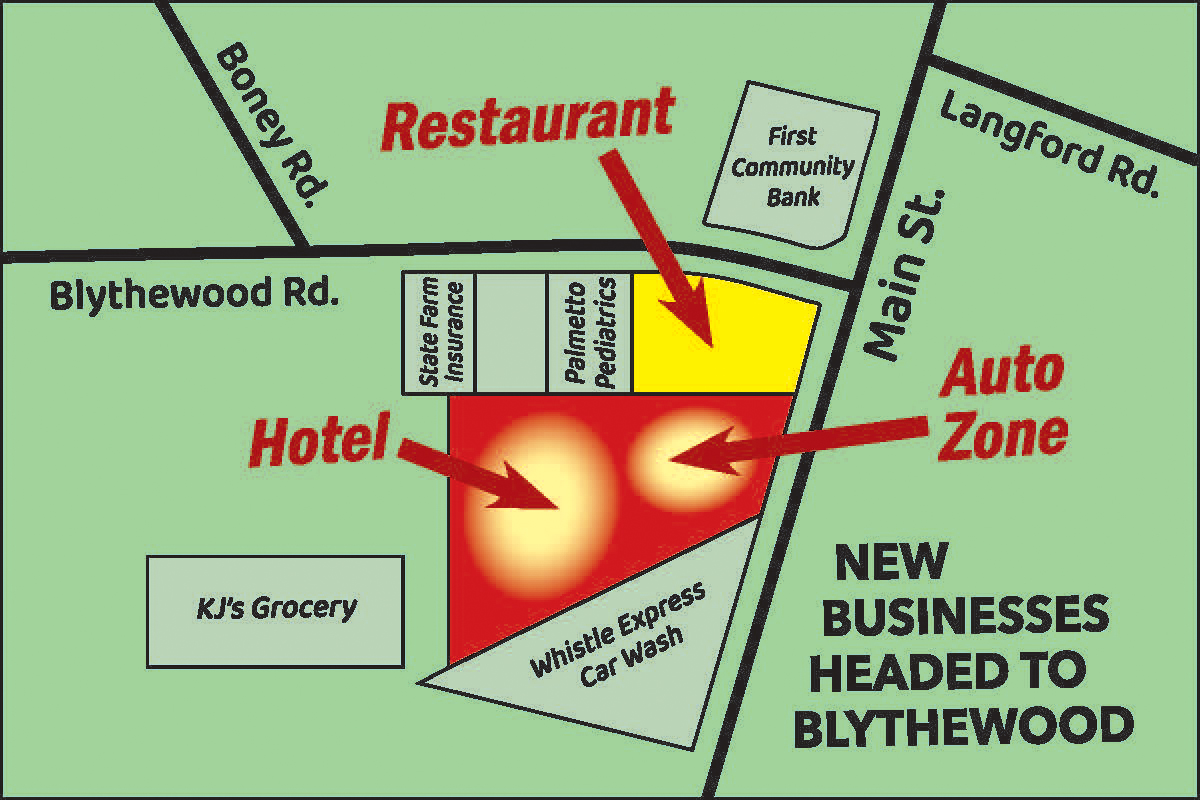
Restaurant, AutoZone, Hotel and More are Eyeing Blythewood
BLYTHEWOOD – Town Council voted Monday, Sept. 28, to impose a moratorium for up to nine months on certain applications requiring review by the Board of Architectural Review (BAR). Such a delay could impact the decisions of 8 of 11 new businesses planning to build in Blythewood, according to developers and property owners of some of those parcels.
According to Town Manager Doug Polen, the moratorium would give the town the time it needs to remove problematic language from the current BAR ordinance and align its requirements with the draft of the town’s new land use ordinance, which was initiated by former Town Manager Daniel Stines in 2024—a consultant-led process that included community input.
According to the proposed ordinance, during the moratorium “the BAR shall not accept, process, approve, or issue a Certificate of Appropriateness” for:
- new principal buildings or structures,
- substantial additions or expansions to existing buildings or structures, as determined pursuant to Section 2,
- major exterior alterations or renovations, as determined pursuant to Section 2, and
- other developments that the Zoning Administrator determines as substantially similar to nature and effect to the foregoing.
“Ultimately, it will take about two to three months for the ordinance to wind its way through the official legislative process of going to the Planning Commission for approval and then to council for two readings,” Polen said. “Plus we will probably want to send it to the BAR at least once so they can see the changes.”
After that, the Town would start taking applications from businesses. Those applications would then go through the BAR and two readings by council, accounting for another three months or so before a Certificate of Appropriateness could be issued for construction to begin.
Developer Zach Grogan said his projects involve approximately six acres at the intersection of Blythewood Road and Main Street (Wilson Blvd.) encompassing property owned by Blythewood Oil and the Creech property next to the car wash. Those projects include a hotel, a restaurant and an AutoZone store. Each business requires a separate application.
“It’s a good thing to remove the subjective nature of the way the BAR ordinance is written,” Grogan told The Voice in an interview on Tuesday. “That’s the right thing to do.”
While addressing council at Monday night’s meeting, however, Grogan said he objects to the moratorium on BAR applications while the ordinance changes are being made.
“Is a moratorium absolutely necessary?” Grogan asked. “You put a new zoning (land use) ordinance together two or three years ago, and I don’t think you called for a moratorium then on rezonings. I wonder why a moratorium is necessary now if it wasn’t then.”
Grogan said he had properties developed in Fountain Inn and other towns in the state while they were updating ordinances and there were no problems.
“Developers should be allowed to decide whether to proceed under the existing rules or wait for the new rules,” Grogan said.
“These contracts are all being signed within weeks,” said Larry Sharpe Sr., owner of Blythewood Oil. “Delays caused by a moratorium can be a deal breaker.”
“To have to appear three or four times before a board of architectural review is not favorable, and I’d prefer not to have to do that,” he said. “But it’s a shorter time than this proposed moratorium, and my project would still be moving forward.”
Three of the 11 planned businesses will be able to proceed, including Grogan’s Auto-Zone store and two businesses on property owned by Blythewood Oil Co. on Blythewood Road in front of the Food Lion shopping center. Applications for those three buildings had already been submitted prior to the moratorium being passed.
Because Grogan and Blythewood Oil had not already submitted applications for a hotel on Main Street and a restaurant at the intersection of Blythewood Road and Main Street (Wilson Blvd.), those businesses will come under the new moratorium. Six other businesses planned on property owned by Blythewood Oil will also be delayed by the moratorium.
Last spring, members of Town Council voted to revamp all the town’s boards, including the BAR.
“In discussions I had with business owners in town,” Polen said, “the BAR has been very difficult to work with. That’s not a negative reflection on the BAR. They care about the town. But it goes back to two questions – Does the BAR ordinance reflect what the council wants in terms of processing applications, and does the BAR do what the code actually says to do?”
The problem, Grogan said, goes beyond who serves on the review board.
“There are some excellent lines in the current BAR ordinance that are objective in nature. However, they’re contradicted later in the ordinance,” he said.
Those contradictions allow different interpretations, he said.
The architectural review requirements are also tied to provisions elsewhere in the land use ordinance, making it difficult to revise one section independently, he said.
Still, Grogan questioned why the work should require months, particularly when the town already has a draft.
“I feel like if somebody were focused on it, you could probably turn it around really quickly,” he said.
He acknowledged that town staff has other responsibilities. But much of the underlying work, including hiring a consultant and gathering public input, has already been completed with the land use ordinance.
“The work is largely already done,” Grogan said.
For developers, he said, a delay introduces additional uncertainty after considerable time has already gone into arranging utilities, leases, access and workable construction plans.
“To have a moratorium instituted that potentially puts everything at risk is extraordinarily frustrating,” he said. “Businesses can change their plans, reduce expansion or choose another location while a project waits.”
Grogan said he has already lost prospective tenants to competing developments near Publix and a proposed Walmart, though not because of the moratorium. He emphasized those decisions were driven by the competing locations.
“Such losses can happen with or without a development pause,” he said, “but additional waiting creates another risk.”
With council’s decision made, Grogan said he intends to work with the town manager, identify subjective provisions and continue commenting on the draft ordinance. He also plans to return to council if he believes progress has stalled.
“My project is at risk,” he said. “And I’m going to fight to try and keep it moving as best I can.”