

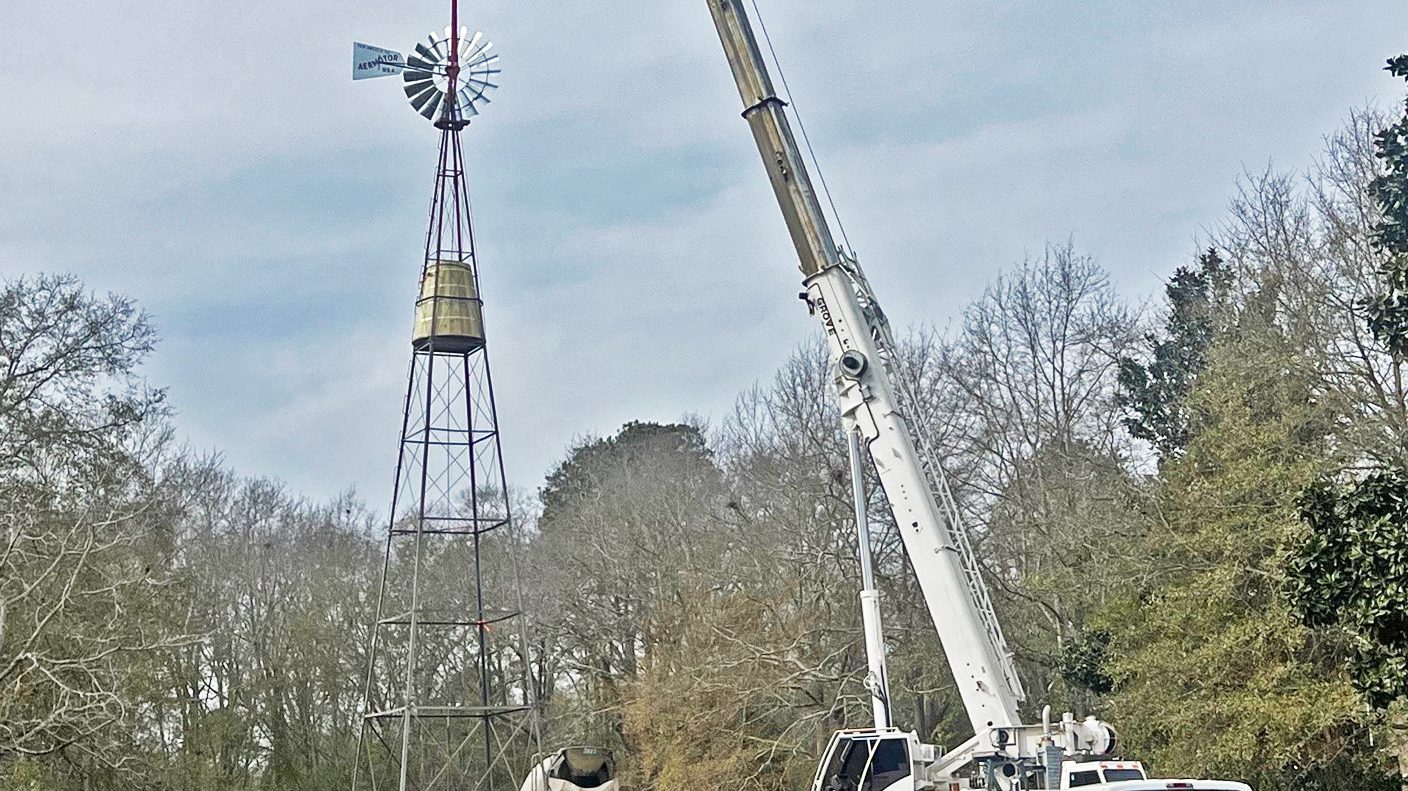
BLYTHEWOOD – The last windmill in downtown Blythewood was erected circa 1920 in the backyard of Durham Boney’s home on Oakhurst Road.
It is now a working windmill in the backyard of the Blythewood Historical Society & Museum. A 1920s-themed ribbon-cutting ceremony will be held to celebrate the windmill on Sunday, Oct. 18, from 3 p.m. to 5 p.m. at the Langford-Nord House located at 100 McNulty Street in Blythewood.
In June, 2025, the then inoperable 70-foot-tall, 105-or-so-year-old windmill was moved to the backyard of the Langford-Nord House, the home of the Blythewood Historical Society & Museum, where it was renovated over the next year. Now its blades whir once again, pumping water from the ground.
After conducting considerable research on how to move a windmill, Jim McLean, a founding member of the Historical Society, learned that the windmill was made by the Aermotor Company and installed by T.M. Haynes. According to the Aermotor Company’s website, the company is still in business in the United States today and ships windmills worldwide.
“Our biggest concern,” McLean said, “was, of course, that it had to be moved over the top of John Miles’ house, and then we had to get it from his house to the Langford-Nord House. It took a lot of planning in that regard, to get the thing moved.”
The Historical Society contacted Bruce Miller, a recognized windmill authority, with The Southeast Windmill Company in Rome, Ga., to assess the situation and, ultimately, to move the windmill.
“Because of the heavy traffic on Main Street (Highway 21) and the size of the tower, we decided to put the move off until after school dismissed for the summer,” McLean said.
“In April 2025, Miller arrived in Blythewood where he spent hours assessing the windmill and calculating the move,” McLean said. “We didn’t want any of the parts to fall off and hit John’s roof as it passed over the top of his house.”
Miller returned on June 6 with a giant crane for a final assessment and partial disassembly of the tower. On Saturday, June 7, the crane slowly lifted the windmill frame over Miles’ home and then onto a trailer and delivered the windmill to the Historical Society’s property.
“The project took a year to complete and cost over $10,000 for the move and $20,000 to $25,000 to repair the windmill and return it to working order,” McLean said, “so we had to raise the funds before Mr. Miller could begin the repairs.”
Once the repairs were finished, Miller installed anchors and poured concrete footings in the ground to support and stabilize the tower. A barrel was placed in the circle at the top of the tower to act as a reservoir for the pumped water as it did in the windmill’s glory days, according to McLean.
“Our goal was for the historic windmill not to be just an ornament, but a working windmill. There is an existing water well in the backyard of the Langford-Nord House and the windmill was placed over it. It now operates just as it did in the 1920s. It will be an educational tool to help students and adults learn about the history and early residents of the town,” McLean said.
The community is invited to attend the ribbon-cutting ceremony.